News · 06/11/2026
Montepulciano, the Face and Time: Identity Portrayed at the Dawn of the 17th Century
On November 7, Montepulciano will bring together scholars of portraiture from the transition between the Renaissance and the Baroque periods. The conference is curated by Massimo Pulini, chaired by Francesca Cappelletti, and dedicated to Mina Gregori.
Colucci Fine Art · 5 min read
by Stefano Colucci
A painted face traverses the centuries, continuing to pose questions to us. It preserves the image of an individual, while also revealing how a specific era chose to view the human being—reflecting their social rank, their ambitions, and their inherent fragility. On November 7, 2026, in Montepulciano, this relationship between painting and identity will take center stage during a scholarly symposium that places artistic work and research back at the heart of cultural discourse.
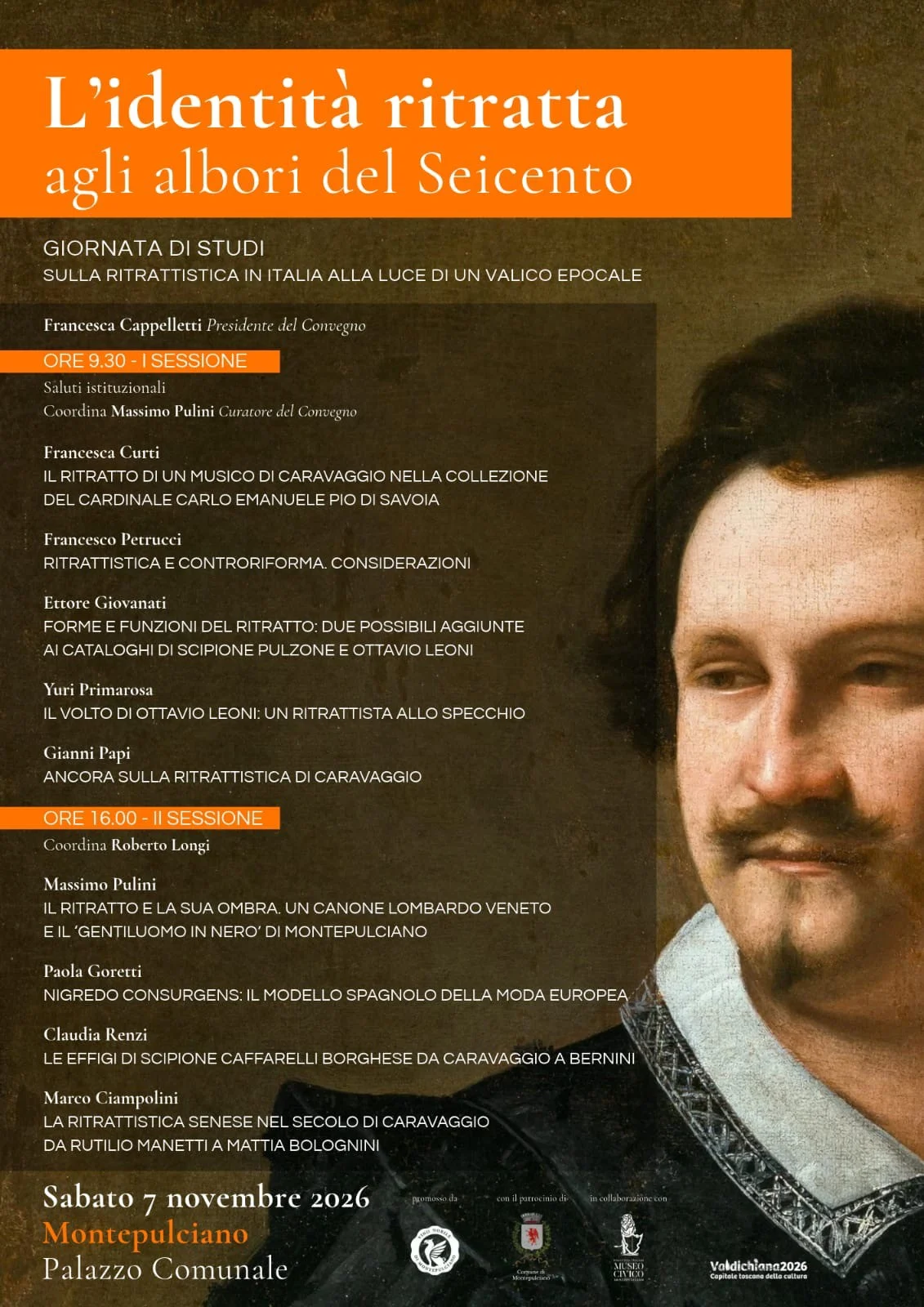
The conference, titled “Identity Portrayed at the Dawn of the 17th Century,” will be held at the Palazzo Comunale and is divided into two sessions, beginning at 9:30 a.m. and 4:00 p.m. The initiative—promoted by the Consorzio del Vino Nobile di Montepulciano in collaboration with the Municipality and with the participation of the Museo Civico Pinacoteca Crociani—is curated by Massimo Pulini and chaired by Francesca Cappelletti, director of the Galleria Borghese in Rome, according to a statement from the organizers. This event is dedicated to Mina Gregori and is part of the initiatives for Valdichiana 2026 – Tuscan Capital of Culture.
The Portrait: A Meeting Point Between History and Presence
Between the late 16th century and the early decades of the 17th century, the portrait served as a privileged vantage point for observing transformations in visual culture. Through attire, posture, and the composition of the subject’s gaze, social representation and individual presence converge. The question of who the depicted person is goes hand in hand with another, equally crucial question: how did they wish to be seen?
The program in Montepulciano explores this transition through complementary perspectives: the Caravaggesque era, the Counter-Reformation, the history of art collecting, period costume, the relationship between painting and sculpture, and the distinct characteristics of regional schools. The value of a scholarly discussion lies in its ability to integrate these various dimensions, rather than reducing a painting merely to the name of its potential creator.
The “Gentleman in Black”: A Work That Reopens the Debate
At the heart of this initiative lies the Portrait of a Gentleman in Black, housed in the Civic Museum of Montepulciano. Following its restoration in 2012, the painting was the focus of a conference chaired by Mina Gregori, which featured contributions from scholars including Maurizio Calvesi, Gianni Papi, Francesco Petrucci, and Massimo Pulini.
The event on November 7th revisits that line of inquiry and expands its scope. For this occasion, the painting has undergone a new, ultra-high-definition photographic campaign, carried out by Gilberto Urbinati. This is a concrete step: observing more closely provides more precise tools for discussion, comparison, and verification. Art-historical research thrives on this willingness to revisit works, allowing details to put existing interpretations to the test.
Pulini’s contribution, “The Portrait and Its Shadow: A Lombard-Venetian Canon and the ‘Gentleman in Black’ of Montepulciano,” situates the painting within a broader figurative context. His role as curator lends continuity to an investigation that links the city’s cultural heritage with scholarly dialogue.
The Morning Session: Caravaggio, the Counter-Reformation, and the Image of the Artist
Following the official opening remarks, the first session—coordinated by Massimo Pulini—begins with Francesca Curti, who discusses Caravaggio’s Portrait of a Musician from the collection of Cardinal Carlo Emanuele Pio di Savoia. This topic highlights the relationship between the artwork, its documentation, and the history of collections—an essential foundation for reconstructing the reception and circulation of images.
Francesco Petrucci explores the subject of “Portraiture and the Counter-Reformation: Some Considerations,” examining the relationship between the representation of an individual and their religious and cultural context. Ettore Giovanati presents “Forms and Functions of the Portrait: Two Possible Additions to the Catalogues of Scipione Pulzone and Ottavio Leoni.” The very phrasing of this title reflects the open-ended nature of attribution work: these proposals are offered for scholarly debate and evaluation.
With Yuri Primarosa’s “The Face of Ottavio Leoni: A Portraitist in the Mirror,” the focus shifts to the image of the artist himself. Gianni Papi, in “More on the Portraiture of Caravaggio,” brings the discussion back to one of the central themes of the day. Taken together, these contributions outline an inquiry in which the subject’s identity, the function of the painting, and the identification of the artist’s hand inform and interrogate one another.
The Afternoon: Attire, Power, and the Geography of Painting
The second session, beginning at 4:00 PM, is moderated by Roberto Longi, former director of the Museo Civico Pinacoteca Crociani. In addition to a presentation by Pulini, Paola Goretti offers “Nigredo Consurgens: The Spanish Model in European Fashion.” Here, costume enters the discourse as a key element in the construction of a subject’s represented identity—the way one dresses is an integral part of the language of portraiture.
Claudia Renzi examines “The Effigies of Scipione Caffarelli Borghese, from Caravaggio to Bernini,” initiating a discussion on the interplay between the patron’s personality and the various modes of his representation.
In his work “Sienese Portraiture in the Century of Caravaggio: From Rutilio Manetti to Mattia Bolognini,” Marco Ciampolini restores prominence to a cultural landscape essential for understanding the diversity of Italian painting.
The richness of the program lies precisely in this multifaceted approach: major figures engage in dialogue with regional schools; the history of collecting intersects with the history of social customs; and questions of attribution are examined alongside the intended functions of the artworks.
A Dedication to Mina Gregori and the Future of Scholarship
The dedication to Mina Gregori links this event to the scholar who presided over the previous symposium in 2012. The announcement honors her as an art historian, a member of the Accademia dei Lincei, and Professor Emerita of the History of Modern Art at the University of Florence. This dedication underscores the value of continuity: every new interpretation emerges, in part, from a dialogue with those who taught us how to observe and how to ask the right questions.
The organizers plan to publish the proceedings, ensuring that the discussions are preserved in a stable, accessible format. This is a significant commitment; a conference achieves its most lasting impact when ideas can be revisited, verified, and utilized for future research.
For those who study, collect, or care for works of art, events like this carry a clear significance: they serve as a reminder that knowledge is an integral part of our responsibility toward our cultural heritage. A painting gains depth when its context, history, and connections are reconstructed. Starting from a single portrait held in its own local museum, Montepulciano opens a broader discussion that sheds light on an entire era of painting.
This is also how a city brings its heritage to life: by transforming it into an opportunity for study and encounter.
Identity Portrayed at the Dawn of the 17th Century
A symposium on portraiture in Italy, viewed through the lens of a pivotal historical transition
Saturday, November 7, 2026 · Palazzo Comunale, Montepulciano
First session: 9:30 AM · Second session: 4:00 PM
Conference Chair: Francesca Cappelletti · Curator: Massimo Pulini
An initiative dedicated to Mina Gregori.
Event information source: press release from the Municipality of Montepulciano—produced in collaboration with the Press Office of the Consorzio del Vino Nobile—and the official program provided to the editorial team.