Insights · 28/10/2026
Lucerne, Monet and Klee: colour does not tell the whole story
From Monet’s mist to Klee’s constructed paper: the Rosengart Collection invites us to distinguish image, technique and material history before valuation.
Colucci Fine Art · 3 min read
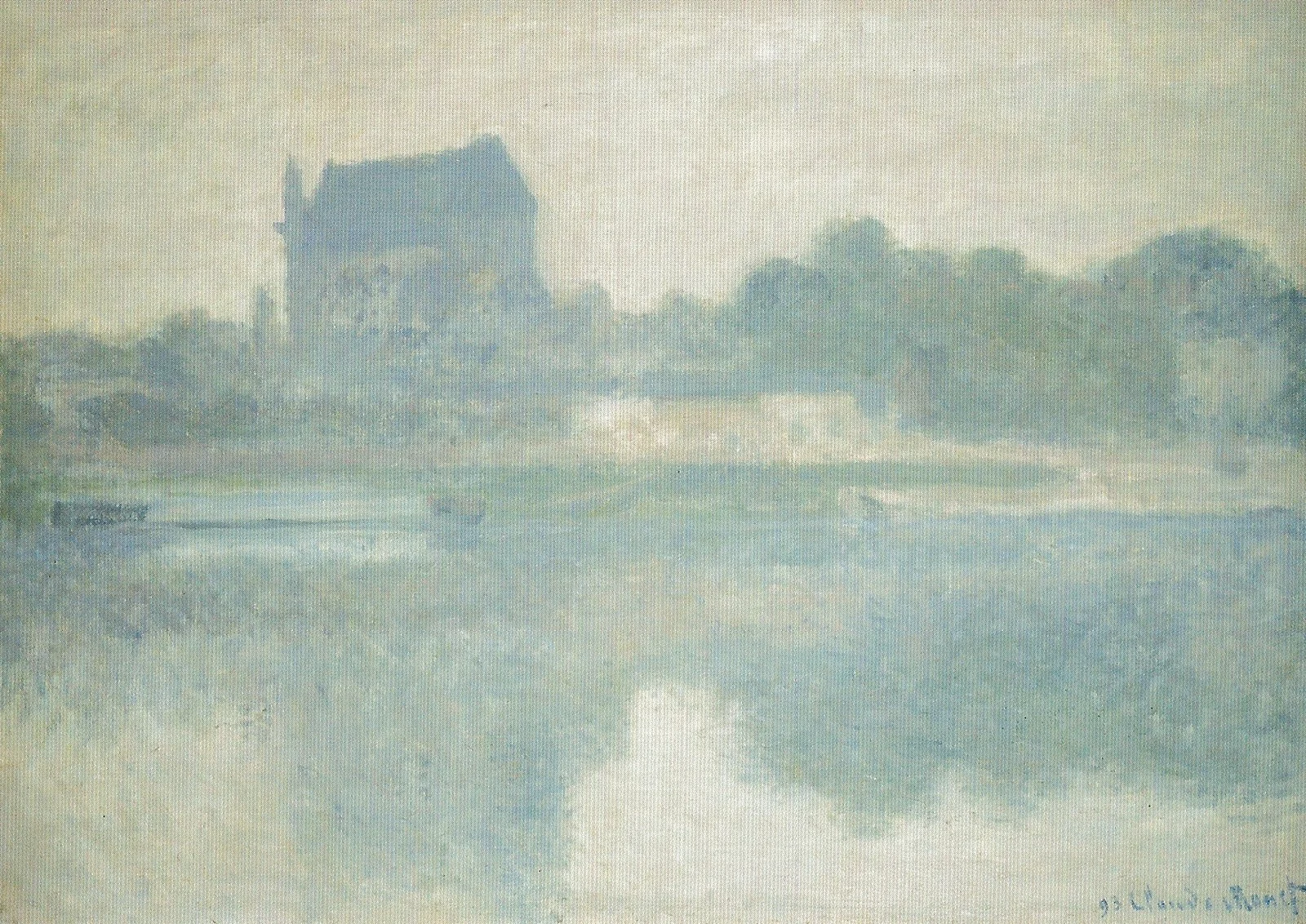
The church is barely visible. Its blue mass emerges from the mist and returns, less certainly, in the water. In Claude Monet’s Vernon Church, Fog, held by the Rosengart Collection in Lucerne, the surface seems to retain an apparition. Painting does not lose the subject; it changes the way we encounter it.
1894, with a different painted date
The collection’s official account dates the work to 1894 and notes that Monet inscribed 1893. This small distinction separates an inscription on the object from the chronology proposed by research. Copying the number without reading the entry would lose that information.
For an owner, the practical consequence is straightforward: transcribe a visible date without automatically treating it as certainty about execution. A record can include both dates and explain their sources. The same applies to notes on a reverse or an old window mount.
Lucerne as a place for comparison
The Rosengart Collection holds a substantial group of works by Paul Klee, including drawings, watercolours and paintings. Comparing techniques raises a question often neglected in reproductions: what supports the colour? A digital image can make materially different surfaces appear alike.

A sheet can be a construction
In Temple Gardens, reproduced here for comparison from another collection, arches, steps and colour fields create a place the eye traverses without finding a single route. Warm colours alternate with cooler areas; vertical divisions interrupt and reassemble the reading.
The Metropolitan’s record describes three sheets mounted on paper and paperboard. This material information matters: a line or join should not immediately be classified as damage. Before suggesting treatment, it is necessary to understand what belongs to the work’s construction and what to its later history.
Comparing images has limits
Monet and Klee are not paired here to suggest equivalent prices. Their images show two ways of organising colour, but assessment must distinguish artist, period, medium, size, condition and documentation. “Work on paper” is too broad a category to serve as an estimate in itself.
Photograph the whole visible sheet without excluding its margins. If a mount conceals the edges, record that fact; it need not be opened for an initial enquiry. Preserve earlier photographs taken before mounting, if available, since they may show inscriptions or edges now hidden.
Presenting a collection from Canton Lucerne
An inventory organised by medium makes an initial discussion with CFA in Balerna more useful. For each piece, distinguish established information from an earlier attribution. Research can then identify whether condition, authenticity or market questions need further attention before a sale is discussed. The institutions cited are independent cultural references, with no commercial affiliation.
Presenting a work to Colucci Fine Art
For an initial discussion, send clear front and back photographs, dimensions and available documents through our valuation enquiry. To discuss a possible consignment, see selling with CFA. Our premises are in Balerna, Ticino; an initial review of the documentation precedes any decision about a sale.
Sources and further reading
- Sammlung Rosengart — Die Sammlung
- Sammlung Rosengart — The artists
- The Metropolitan Museum of Art — Temple Gardens
Image: Claude Monet, Église de Vernon, brouillard, 1894 — Sammlung Rosengart, Lucerna. Claude Monet · Public domain · Wikimedia Commons. Photograph reproduced with automatic web resizing.
CFA Editorial