Insights · 29/10/2026
From Graubünden to Europe: Angelika Kauffmann and the art of self-presentation
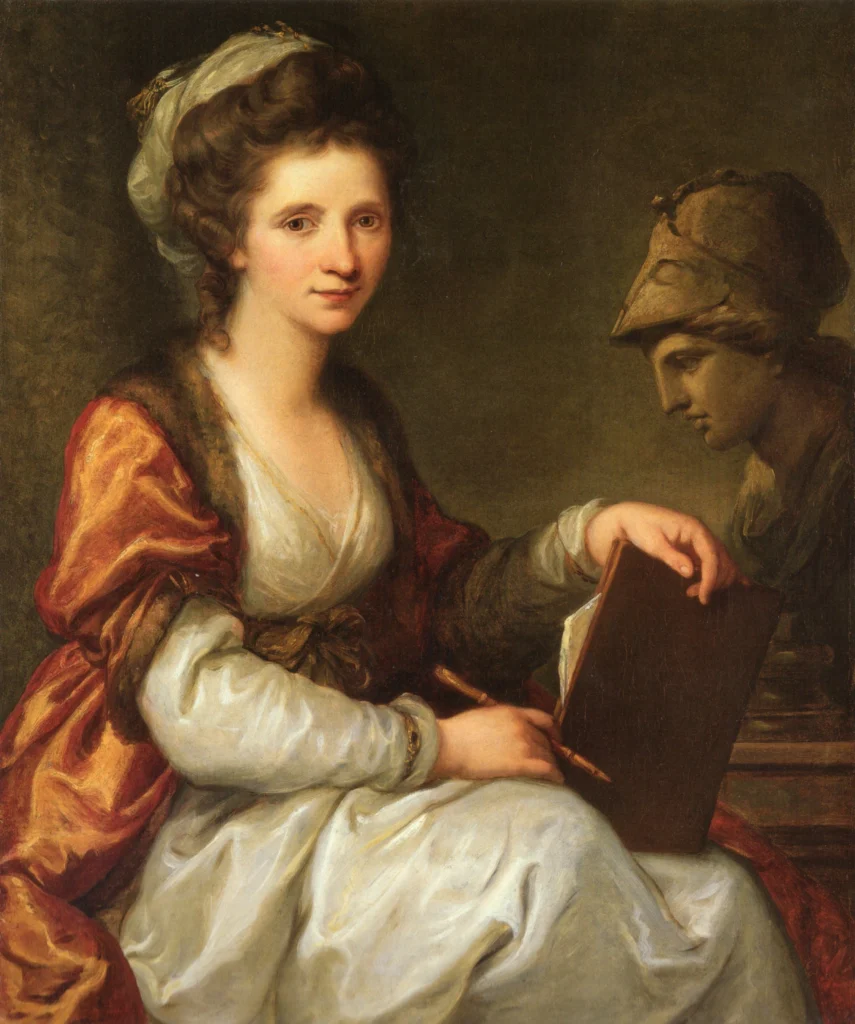
The Self-portrait with Bust of Minerva invites us to read clothing, tools and poses in eighteenth-century portraiture.
Colucci Fine Art · 3 min read
A figure looks towards us while a classical bust occupies the space beside her. Clothing catches the light, but drawing tools redirect the image’s meaning. We see more than an elegantly represented woman: a painter is choosing how she wishes to be recognised.
Chur, London, Rome
Born in Chur in 1741 and deceased in Rome in 1807, Angelika Kauffmann worked between Italy and England. The Bündner Kunstmuseum holds an important group of her works, connecting Graubünden with European artistic culture.
In the Self-portrait with Bust of Minerva, drawing tools identify her profession. The Royal Academy’s 2024 guide dates the painting around 1780–1784 and connects it with her return from London to Italy.
Reading the objects
Bust, drawing materials and clothing construct a presentation. Their meaning need not amount to an inventory of possessions: a portrait object can express a role, interest or aspiration. We should read those relationships before turning them into biographical facts.
Follow the movement of attention from face to hand, from hand to tools, then towards the sculpture. Several focal points coexist without dissolving the figure’s unity. This is a visual reading of the reproduced painting, distinct from documented information about its history.
Beyond portraiture
The Chur museum also discusses Kauffmann’s history painting through small copper paintings of Penelope and Calypso, dated 1775–1778 and acquired through the 2021 Fulda donation. An artist can be studied across genres and supports.
Comparing an old picture should not stop at the face or an artist’s most familiar subject. Format, medium, hands, drapery and spatial construction raise connected questions. An isolated resemblance does not establish attribution.
Family portraits in Graubünden
An inherited portrait may have a securely identified sitter but an uncertain maker, or the reverse. Record these as separate questions. A name on the back might identify the subject, an owner or an earlier attribution. Document its position and lettering without completing the story by assumption.
From Balerna, CFA can review dossiers on portraits and paintings in Graubünden to discuss valuation and a possible sale. The museum work illustrated is a cultural reference, not an auction offering from CFA.
Presenting a work to Colucci Fine Art
For an initial discussion, send clear front and back photographs, dimensions and available documents through our valuation enquiry. To discuss a possible consignment, see selling with CFA. Our premises are in Balerna, Ticino; an initial review of the documentation precedes any decision about a sale.
Sources and further reading
- Bündner Kunstmuseum — Angelika Kauffmann
- Bündner Kunstmuseum — Kauffmann, nuove acquisizioni
- Royal Academy — Angelica Kauffman, guida alla mostra 2024
Image: Angelika Kauffmann, Autoritratto con il busto di Minerva, circa 1780–1784; Bündner Kunstmuseum, deposito della Fondazione Gottfried Keller. Angelika Kauffmann · Public domain · Wikimedia Commons. Photograph reproduced with automatic web resizing.
CFA Editorial