Insights · 28/10/2026
Giovanni Serodine: Ascona, Rancate and the history of Ticino collections
From Ascona to the Züst collection: reading faces, documents and ownership history before assessing an Old Master work.
Colucci Fine Art · 3 min read
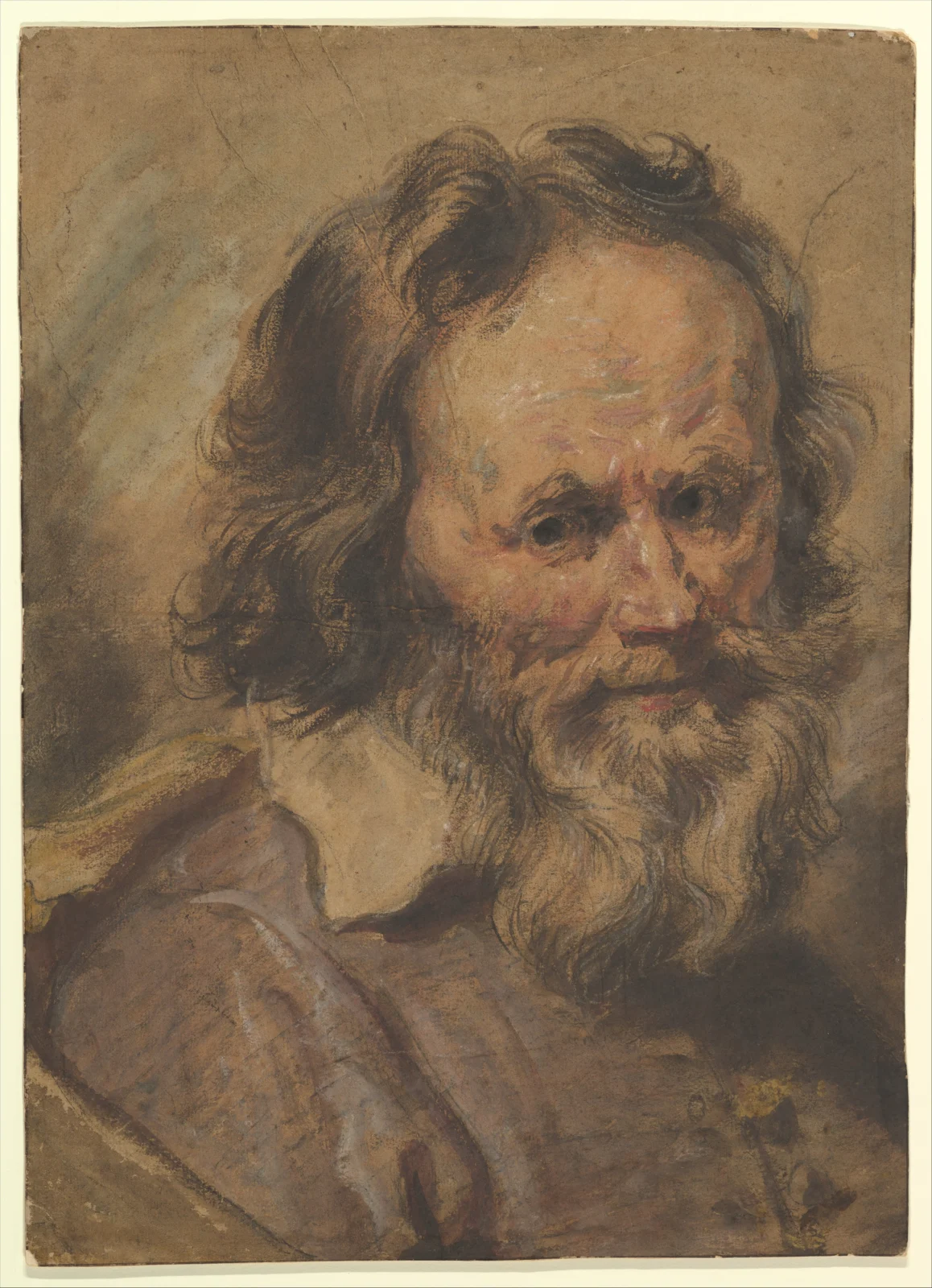
A face fills almost the entire sheet. Dark hair, a beard and deep-set eyes emerge from a surface where marks and colour remain evident. The Head of a Bearded Man illustrated here encourages close looking before the search for a stylistic label. Giovanni Serodine also offers a route through the works, places and collections of Ticino.
Ascona and a biography with uncertainties
Serodine belonged to an Ascona family of artists active in Rome. The Historical Dictionary of Switzerland leaves his birth date and place uncertain and records his death in Rome in 1630. That uncertainty should be preserved rather than replaced with an apparently definitive local biography.
Ascona should not be confused with the Mendrisiotto. Connections between these areas can be explored through works and their histories. A map of artistic heritage is not simply a map of birthplaces: churches, museums and collections also record later movements and decisions.
From Lugano to Rancate
The Zeri Foundation records Saint Peter in Prison at the Züst gallery in Rancate, with earlier locations in the Züst collection in Rancate and the Grecchi Luvini collection in Lugano. An object record can thus connect places and collectors.
Ask not only where a work is now, but which evidence describes its earlier movements. A collection name starts a line of research; it does not reconstruct every transfer. Sources, dates and identification of the actual object need to support the sequence.
Reading a face without making an attribution
In the opening image, the light forehead contrasts with the dark eyes. Broad curved marks describe the hair; directional strokes and tonal variations shape the beard. The figure retains contours of changing intensity rather than simply dissolving into the background. These features can be observed before discussing authorship.
This reading concerns this reproduction. It does not make every bearded head or dramatically lit figure a Serodine. Comparison with a privately owned work requires suitable images, identification of medium and support, documents and specialist examination. A shared subject is only a starting question.
Why old family records matter
An inventory may describe a work as a philosopher, an apostle or simply a portrait. A changed title alone does not prove that records refer to different objects; identical titles do not establish that they describe the same painting. Measurements, support, photographs and distinctive features help test the connection.
Keep apparently outdated notes and record their author and date where known. Add an updated record rather than altering original documents. An attribution no longer accepted may still matter to the history of collecting. Concealing the difference makes the dossier less transparent.
Research before a sale proposal
For a private collection in Ticino, Como or Lombardy, begin with the individual works. Gather photographs, measurements, invoices and older catalogues. Distinguish surviving evidence from recollections and avoid filling gaps with assumptions.
Colucci Fine Art receives visitors in Balerna by appointment. Contact the Old Master Paintings department or send a valuation enquiry to discuss research and a possible private sale or auction. An initial assessment is neither authentication nor a guaranteed price; it helps define suitable next steps.
Sources: Laura Damiani Cabrini, Historical Dictionary of Switzerland; Zeri Foundation, Saint Peter in Prison. Visual interpretation by the editorial team.
Image: Serodine, Head of a Bearded Man. Metropolitan Museum of Art, 2000.21. Source: public domain. Museum illustration, not offered for sale by CFA.
Colucci Fine Art editorial team